Rumination About the Past
Rumination doesn’t usually start as a problem.
It starts as the mind trying to understand something that didn’t sit right.
This might be a conversation that ended badly, a mistake you wish you handled differently, or a particular moment where you felt misunderstood, ashamed, or mistreated.
You replay these thoughts…then you replay them again.
And the problem is you don’t do this because you enjoy it, but because your mind is looking for closure.
This page is about understanding why rumination happens, the reason it feels so difficult to avoid, and practical strategies for how to reduce the amount of time you spend trapped replaying the past.
Explore rumination
Rumination Is the Mind Seeking Closure
Rumination is your brain revisiting past events that feel unresolved.
Moments where things didn’t go the way you expected. Maybe you didn’t get to say what you wanted to say, which leads to feelings of regret, shame, or sadness.
Your mind returns to these moments because it believes something is unfinished.
It wants resolution, relief, and a way to release the negative emotions that are associated with these thoughts.
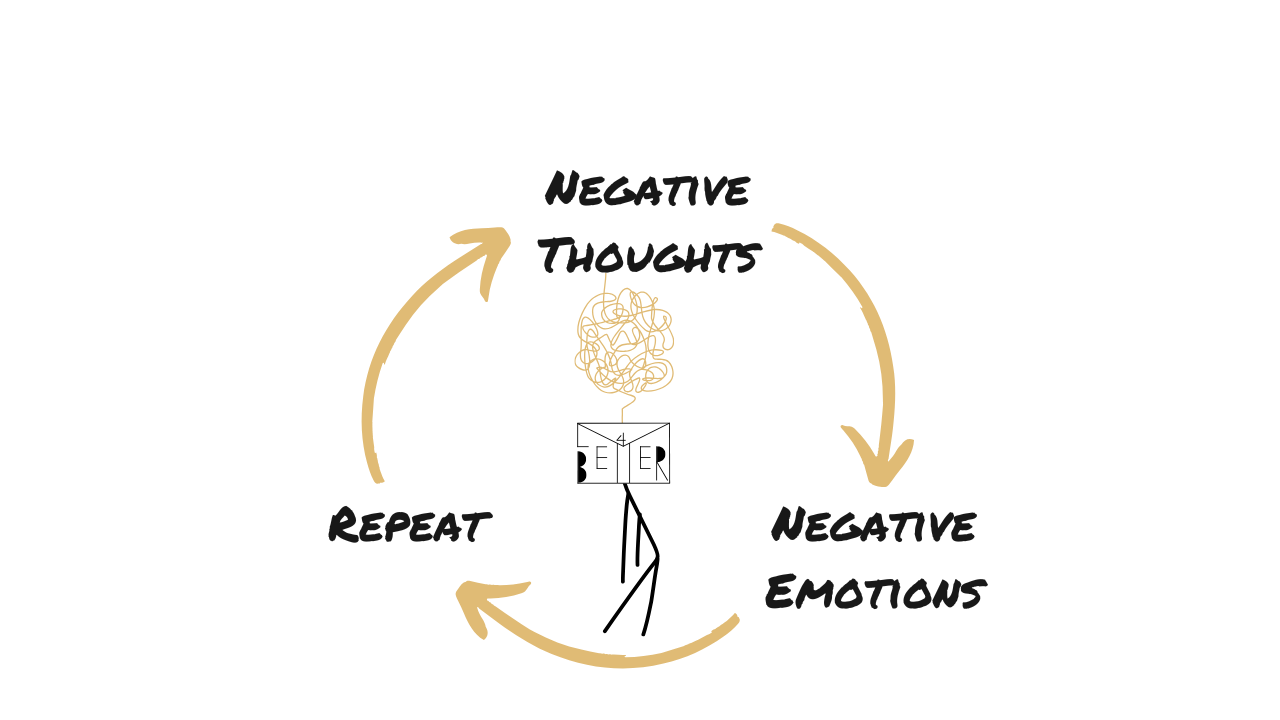
But the problem is that replaying the past doesn’t create closure, it just creates repetitive negative thought loops.
You Can’t Stop Rumination From Starting (But You Can Shorten It)
People want to stop ruminating completely, and it’s easy to understand why.
The reality is you can’t actually stop yourself from the start of rumination because it often begins automatically, especially when the mind is idle.
But what you can do is improve how quickly you notice rumination once it starts.
The real goal isn’t elimination; it's a reduction in the amount of time you spend ruminating.
Think about it like this. If you currently ruminate for an hour a day, then cutting it down to five minutes is already a massive improvement.
And this is a skill that you can develop with practice, where the goal is to continue shortening the gap between when rumination starts and when you decide to shift out of it.
Awareness Is the Exit Point
One of the easiest and less talked about ways to stop ruminating is to simply observe your thoughts as they occur.
When you’re able to notice your thoughts in real-time, this gives you the power to choose your next thought.
Once you notice a negative thought loop, it creates a pause.
And in that pause, you regain agency.
This is why mindfulness matters. It becomes a practical tool that allows you to realize when you are ruminating and then jump out of the mental spiral.
The Difference Between Rumination and Worry
Rumination and worry feel similar, but they actually point in different directions.
Rumination replays the past, while worry simulates the future.
They’re both negative and consume your mental energy, where neither gives you a sense of control.
You can’t rewrite the past and you also can’t fully control the future.
And that’s why both create emotional pain without producing progress.
So when you know what kind of loop you’re in, you’re able to apply the right mental framework to reclaim your mental clarity.
Why Rumination Creates Suffering
The reason rumination feels painful is because it’s internally focused.
It’s built on self-referential thinking, which involves the part of your brain called the Default Mode Network.
The Default Mode Network and Self-Referential Thought
The Default Mode Network activates when your mind turns inward.
It’s responsible for thoughts about:
- Who you are
- What happened to you
- How others see you
- And rumination often lives here.
- It loops around your identity and negative events in relation to it.
- This is why prolonged rumination can lead to low mood or even depression.
The mind gets stuck circling around the self, and negative thoughts about your self is what creates suffering.
Label Your Thoughts to Break the Loop
Here’s the uncomfortable truth about rumination. Rumination pulls you in because it feels so personal.
These thoughts feel like you. And this is how labeling becomes effective.
Labeling creates distance.
When you name a thought, you stop being inside it and start observing it. This shifts the brain from emotional immersion to cognitive awareness, which reduces the intensity of the loop.
Instead of continuing to debate your thoughts, you recognize the pattern.
So when you understand why you are ruminating and see this repeated pattern, you reduce the hold that rumination has on you.
Once you name a thought, you don’t feel the need to suppress it or fight it. You simply stop feeding it because you understand it by seeing it from a different angle.
And the moment you stop feeding rumination, it stops being something you need to resist. Because what you mentally resist will persist.
Rumination vs Reflection
Thinking about the past is not all bad.
The difference boils down to intention and outcome.
What Makes Rumination Unhelpful
Rumination is when you revisit the past without uncovering any new or beneficial information.
It’s emotionally charged and loops without learning.
Rumination just keeps you stuck, often causing you to ask the question of “why did this happen to me?”
What Makes Reflection Useful
Reflection on the other hand allows you to extract insight. It leads to a lesson that can help inform your future behavior.
The difference is that reflection ends thought loops because it provides answers, while rumination continues to replay because your mind is still tied to negative emotions that it’s trying to solve and release.
That’s why the mind keeps looping.
A Simple Reframe for Breaking Rumination
Sometimes the mere act of recontextualizing why you think certain thoughts can help you minimize repeating them.
Instead of asking, “Why do I keep ruminating about this?”
Ask yourself, “Is this helping me resolve something, or am I just wasting my time and energy replaying it?”
You’ll clearly know the answer.
When you reframe rumination as a restriction to your own time, energy, and peace; it gives you a clear justification to immediately redirect your attention.
So instead of trying to avoid the past, you choose to accept it and stop living in it.
How You Can Move Forward
Rumination is something you can overcome.
It’s a pattern driven by a mind that wants closure.
Your leverage points are awareness, labeling, and redirection.
Just remember that your mind will always default to the thoughts it rehearses the most.
You don’t need to eliminate negative experiences from your past, but instead, stop rehearing them.
Free eBook
7 proven methods to stop overthinking.
Interrupt the loop, decide without waiting to feel certain, and take action. Downloadable right on the page.
Get the free eBook