Life can get pretty hectic, and it can feel like we’re being pulled in a million directions.
Between social media, advertisers, and the endless barrage of negative news, it’s easy to feel overwhelmed. But here’s a thought: What if you could take control of your attention and refocus it on what truly matters?
In this article, we zoom out and explore the concept of the circles of control. By emphasizing the attention economy, and breaking down the circles of control, influence, and concern, we learn how to prioritize our energy and focus on what can lead to greater self agency and clarity.
The Attention Economy: A Battle for Your Mind
We live in an era where everyone is vying for your attention. Social media platforms want you scrolling, advertisers want you buying, and the news agencies want you amped up emotionally.
But what exactly is your attention? Think of it as your most valuable resource, made up of your time, energy, and focus. The kicker is that whatever you give your attention to, grows. If you focus on negativity, fear, or comparison, those feelings multiply. But if you direct your attention toward self-improvement, growth and connection, that is what will thrive.
The real question is: Are you in control of where your attention goes, or are you letting the world decide for you?
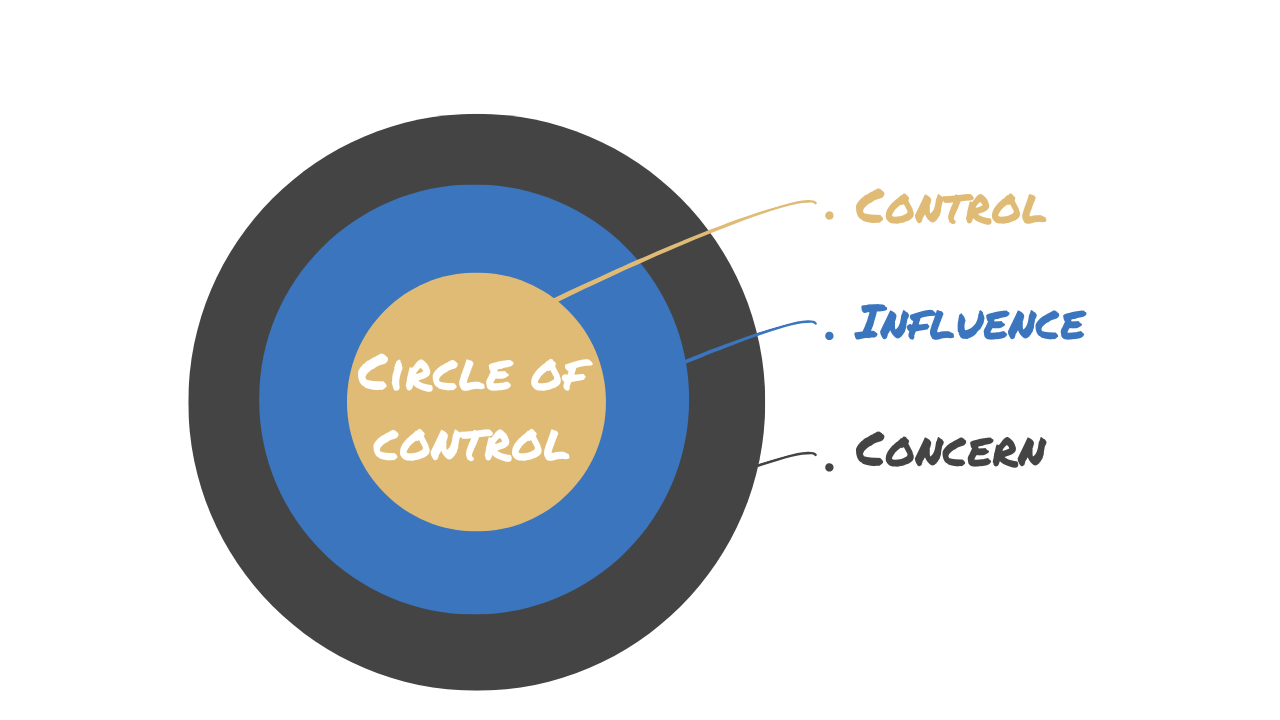
To reclaim your attention, it helps to understand the circles of control, a concept that organizes your life into three layers:
Circle of Control: These are the things you have direct power over—your thoughts, actions, habits, and choices. For example, you can’t control whether it rains, but you can carry an umbrella.
Circle of Influence: These are areas where you can affect change indirectly, like your relationships, team dynamics at work, or your local community. While you can’t necessarily control other peoples’ actions, you can influence outcomes through how you communicate.
Circle of Concern: These include things you might care about but have no control over, like global politics, celebrity gossip, or the economy.
Here’s the dirty trap many fall into: spending excessive time and energy on their circle of concern. Can you think of someone who constantly argues about politics (online or offline) but neglects their own mental and physical health or relationships. They might not realize that their heightened stress and anxiety stems from a feeling of powerlessness because their focus is misplaced.
It’s important to emphasize that understanding these circles isn’t about ignoring the world around you. But rather, applying self-awareness to refocus your attention on what you can control, rather than being overwhelmed by what you can’t.
Taking Inventory of Where You Spend Your Energy
When you zoom out, and look at your life through the layers of these circles, you might notice patterns. This awareness will allow you to take inventory of your life and prioritize what matters most.
Just imagine your time and energy as investments. Are you pouring them into areas that yield the greatest return, or are you wasting them on things outside of your control? When you focus on your circle of control, you’re applying leverage to areas where you’ll get the highest return for your energy. These areas of control can include improving your habits, nurturing relationships, or pursuing personal goals.
Self-awareness is the key to applying the circles of control to your life. Take a step back and ask yourself: Where am I investing my time, energy, and focus? Over time, as you build personal agency and discipline, your circles of control and influence can naturally expand.
Empowering Yourself with Control
If you’re not sure where to start, here are some questions to help you reflect on your circles of control and influence:
- Am I focusing my attention on things I have no power to change?
- How can I let go of these concerns that don’t serve me?
- What are areas in my life that I can directly control and influence?
- Where can I create the most meaningful impact with my time and energy?
5. How can I take small, intentional actions to redirect my attention towards these things?
Reflecting on these questions can help you recalibrate your focus on what truly matters to you.
Wrapping it Up
Your attention is one of your greatest assets. When you understand the circles of control and learn to prioritize your focus, you take back your sense of self agency. This can also prevent having a victim’s mentality or complainer’s mindset. It’s not about ignoring the world’s challenges, but about managing your precious time and energy in a way where you show up as your best self.
Just remember, whatever you choose to feed with your attention grows. You have the power to choose wisely, and watch your life transform.
Sincerely,
Dexter Lam
The 5 Day Overthinking Reset
Overthinking isn't a thinking problem.
Five short emails on what's actually keeping the loop alive. The mechanism, not the motivation. Free.
Start the Reset